
How Much Does It Cost to Clean Out a Pond in Oklahoma?
Angi’s 2026 guide puts pond dredging at $20 to $60 per cubic yard of sediment removed. By the acre, Angi lists $5,000 to $30,000. Whole projects range from $2,500 to $40,000, with a national average of $15,000.
Those are national figures from a cost publisher. Where one Oklahoma pond lands depends mostly on how much silt sits in the basin. We handle pond cleanout and dredging work on farm and ranch ponds out of Ada. Our estimate is free and comes from looking at the pond.
How much does pond dredging cost?
Angi updated its figures on May 30, 2026. It prices a cleanout by the yard, by the acre, by pond size and by method.
| What Angi prices | Published national range |
|---|---|
| Per cubic yard of sediment removed | $20 to $60 |
| Per acre of pond | $5,000 to $30,000 |
| Half acre farm pond | $7,000 to $18,000 |
| One acre farm pond | $15,000 to $30,000 |
| Mechanical dredging with excavators or backhoes | $10,000 to $30,000 |
| Hydraulic dredging with pumps | $15,000 to $40,000 |
| Mobilization, bringing equipment and crew in | $1,000 to $3,000 or more |
| Sediment disposal, hauling and landfill fees | $500 to $5,000 |
Angi says most contractors charge by the cubic yard or by the acre. On a per yard price, silt depth becomes the big number. A foot of silt over one surface acre is about 1,613 cubic yards.
A new pond prices differently. Our guide to pond building costs in Oklahoma covers that dig.
What makes one pond cleanout cost more than another?
Silt volume leads. Angi calls pond size, both surface area and depth, one of the biggest cost drivers. Ponds with deep sediment layers take more labor and machine time.
The volume math takes one line. Multiply the surface acres by the feet of silt, then by 1,613. A half acre pond carrying two feet of silt holds about 1,613 cubic yards.
Access comes next. Angi says ponds close to roads are easier and less expensive to service than hard-to-reach ones. Rural sites can have lower rates but higher mobilization costs due to distance.
Angi’s prep list includes clear access to the pond, even if gates or fences come down for a while. Irregular shapes and uneven depths add cost too. Angi adds that waiting too long between cleanouts lets the buildup raise the final bill.
Is it cheaper to drain a pond before cleaning it out?
Yes, by Penn State Extension’s account. Its fish pond guide calls draining the water and using a bulldozer the least expensive method. A dragline working with the water in is quicker but more expensive. On a small enough pond, a backhoe can do the work.
Angi’s method prices follow the same line. Mechanical dredging uses excavators and suits larger ponds with accessible banks. Hydraulic dredging uses pumps and hoses to suck up sediment, for deeper or hard-to-reach ponds. Angi prices hydraulic work at $15,000 to $40,000, against $10,000 to $30,000 for mechanical.
Timing sets up the draw down. OSU Extension puts evaporation from shallow Oklahoma ponds at 30 to more than 40 inches from May through October. Angi calls late fall or winter the best time, with lower water levels and dormant plants. A firm basin carries the machines, and a wet one keeps them on the bank.
Where does the silt go after a pond cleanout?
Penn State says the spoil should be spread to promote drying. It goes away from the water, behind a vegetative buffer or sediment trap. Once the spoil dries, it can be permanently seeded.
Keeping it on the place saves the haul. Angi puts sediment disposal, for hauling and landfill or composting fees, at $500 to $5,000. Angi also says to ask whether the sediment will stay on the property. Spoil that stays on the place gets spread and shaped as part of our dirt work around the property.
How often does a pond need to be cleaned out?
Angi says most ponds need dredging every five to 15 years. Runoff and sediment load set the pace. Ponds near farm fields or construction can need it sooner.
What washes in decides it. OSU Extension says pond basins are vulnerable to being filled in by soil that washes in. OSU calls dirt roads a major source of clay, silt and sand washing into ponds. Thin grass cover in the watershed lets erosion muddy the water.
OSU adds that sediment can greatly reduce basin volume. It says a small sediment entrapment pond above the main pond can be useful. Penn State recommends a buffer strip of vegetation around the pond to trap sediment.
Angi’s warning signs are reduced water depth, murky water and more algae. Penn State calls deepening shallow ponds the most permanent way to prevent aquatic weeds. It says submerged plants seldom become a serious problem where most of the water is over 10 feet deep.
A pond that loses water fast has a different problem. Our guide to tracking down a pond leak covers that one.
When does a pond cleanout turn into dam work?
Penn State says a pond with high inflow and no drain can need a cut through the dam. The cut goes deeper than the pond bottom, to drain the water from the sediment. After the sediment comes out, Penn State suggests a bottom drain through the cut, then a dam repair.
That is dam work, and the Oklahoma Water Resources Board regulates it by size. OWRB requires a permit before anyone alters, removes or repairs a dam more than 25 feet high. The same applies to a dam storing more than 50 acre-feet. OWRB says its review takes 60 days on average with complete paperwork.
Can the state restock a pond after a cleanout?
The Oklahoma Department of Wildlife Conservation stocks new or reclaimed farm ponds. ODWC takes applications for ponds of at least a half acre that hold no fish. A pond drained dry for a cleanout holds none. Applicants need a current Oklahoma fishing license, and the pond cannot charge a fee for fishing.
ODWC stocks 100 largemouth bass, 100 channel catfish and 500 bluegill per acre. Pickups run in the fall and the following spring. ODWC says hatcheries run on license sales, which is how landowners share the cost of the fish.
How do we clean out a pond?
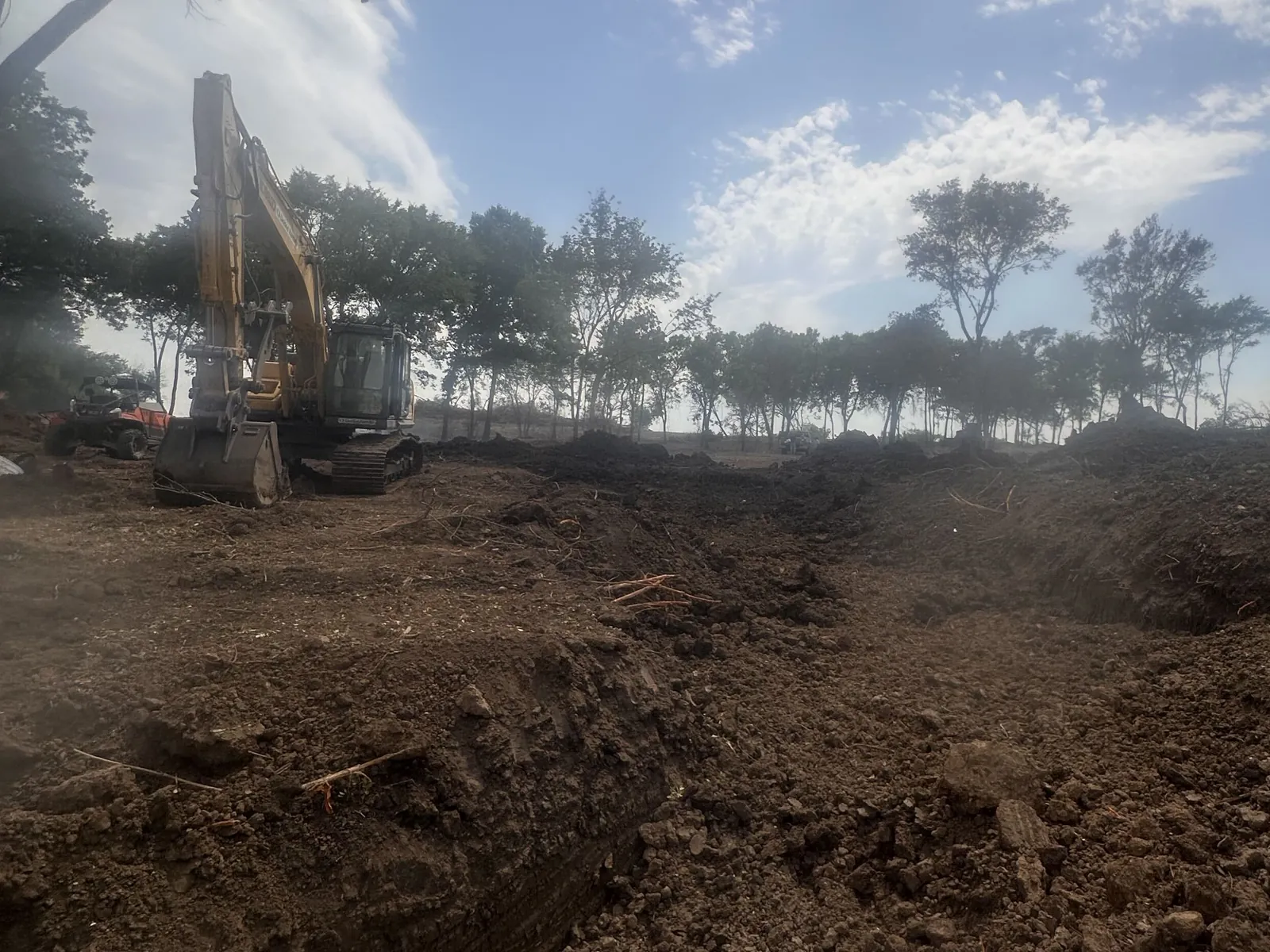
Our end is the dirt. The cleanout waits for a draw down, when the basin is firm enough to carry a machine. Then the 30,000 pound excavator pulls the silt and muck out. The Cat D6 dozer pushes the basin back to shape.
We file an OKIE811 locate request before the machines dig, so utilities can mark buried lines. We give at least 48 hours of notice. The day of the call, weekends and legal holidays do not count. The ticket is good for 14 calendar days from the excavation start date.
The same machines handle building a new pond from scratch, with a core trench and clay packed in thin layers. Our page on cleaning out silted farm ponds covers dam and spillway repair too. Call (580) 344-7473 for a free estimate on cleaning out your pond.