
Why Is My Pond Leaking? How to Fix a Leaking Pond in Oklahoma
A dropping water line is not proof of a leak. OSU Extension puts evaporation from shallow Oklahoma ponds at 30 to more than 40 inches from May through October. In OSU’s worked example, a one-acre pond in the southwest part of the state lost 3.36 acre-feet, about 1.09 million gallons, in six months.
Faster loss than that has three sources: the basin, the dam, or a watershed that never sends enough water. Sorting out which one comes before any dirt moves. We handle the dirt end of cleanouts and dam repair out of Ada. Here is how a leaking pond gets worked out.
Is the pond leaking or is it evaporation?
Start with the rate of loss. K-State Research and Extension says about half an inch a day can go to evaporation in hot, dry, windy weather. Clemson Extension puts normal summer evaporation at 0.25 to 0.5 inch a day. Penn State Extension says even a well built pond on good soil loses about an inch a month to seepage.
Penn State adds that evaporation and water-loving trees rarely take more than 12 inches in the driest month. A faster drop than that points at a leak. The Oklahoma Department of Wildlife Conservation says a slight drop by itself is normal in warm weather. Set a stake at the water line and read it for a week.
Oklahoma has more than 326,000 ponds by OSU’s count, and plenty of them drop every summer. The ones that keep dropping after the weather breaks are where our pond repair work on farm ponds starts.
Where does a pond lose water?
There are three places to look. OSU Extension says many pond owners jump to the conclusion that the dam is the problem. Often it is not.
A pond that never held water usually has a basin problem. OSU names sandy soil, rock outcroppings and gravel or sand layers. A pond that used to hold water and now does not is more likely leaking through or under the dam.
The watershed is the third place. OSU says a pond that will not fill may simply have too small a watershed. The Southern Regional Aquaculture Center (SRAC) says an altered watershed sends less water in, which reads like a leak.
In arid parts of Texas and Oklahoma, SRAC ties subsurface caliche and gypsum to leaky ponds. Ground changes fast around here too, and the Arbuckles southwest of Ada run to limestone and dolomite.
How do you find out where a pond is leaking?
Walk the dam and the banks after a hard rain. OSU Extension says regular walking inspections pay off by catching problems early. A new damp or wet spot on the back slope of the dam gets flagged and watched. Penn State points at wet areas and water-loving plants like cattails at the base of the dam.
Dye narrows it down. Penn State says sprinkling a little solid, food-grade dye near a wet area helps show whether water is leaving there. Fast flows are the sign that cannot wait. OSU calls a fast leak or flow a serious warning flag of internal erosion.
What does it cost to fix a leaking pond?
OSU Extension says the expense of fixing a leaky pond is often cost-prohibitive. OSU also says earthmoving is the largest single cost of a pond, and contractors charge by the cubic yard.
| Published fix | What published figures say | Source |
|---|---|---|
| Drain and re-compact the basin | $300 to $1,000 per acre, 1999 figures | SRAC 105 |
| Clay blanket, 1 foot or more, packed in layers | Local clay, priced by the cubic yard moved | OSU Extension, SRAC 105 |
| Bentonite worked into the basin | $3,500 to $4,000 per acre for the material, 1999 figures | SRAC 105 |
| Dispersants such as soda ash | Chemical cost only, and the basin still has to be compacted | SRAC 105 |
| Plastic or vinyl liner | About $10,000 per acre | OSU Extension |
| Cut out and rebuild the leaking dam section | Priced by the cubic yard of dirt moved | OSU Extension |
The SRAC prices come from a fact sheet dated January 1999, so read them as 1999 figures. Our guide to what a new pond costs covers new builds instead. Our estimate on a leaking pond is free.
Can a pond leak be fixed without draining it?
Rarely, by the published methods. Texas A&M AgriLife calls the sprinkle method, granular bentonite spread through standing water, less effective than the others. OSU says powdered bentonite is only recommended when a pond is empty. Penn State says in most cases the pond will need to be drained.
The real fix waits on a draw down or a dry spell. ODWC says draining and compacting the existing soil works when the soil holds a good mix of clay. OSU’s rule of thumb is 30 percent clay or more. Where the soil runs too coarse, ODWC adds clay in layers 6 inches to 1 foot thick.
Will a pond seal itself over time?
A new pond often tightens up on its own. SRAC says new ponds commonly have high initial seepage rates that decrease over time. Microbial activity, fine sediment and organic matter seal the bottom. A pond sealed that way leaks again once it is dried or re-worked, until the seal re-establishes.
That is not a plan for an old pond that has quit holding. OSU says flatly that there are no guaranteed solutions. Waiting on a natural seal costs a season of water.
Does repairing a pond dam need an OWRB permit in Oklahoma?
The Oklahoma Water Resources Board regulates by dam size. OWRB requires a permit before you construct, enlarge, alter, remove or repair any dam more than 25 feet in height. The same applies to a dam holding more than 50 acre-feet. OWRB says the review process takes 60 days on average with complete paperwork.
Most farm ponds sit under both numbers. OWRB’s fact sheet says an application may be unnecessary for a dam under 25 feet that holds less than 50 acre-feet. That changes when habitable structures sit below the dam. A separate agriculture exemption covers a low hazard dam under 25 feet that holds less than 100 acre-feet. It has to serve mainly agriculture and be built with a local conservation district or a federal agriculture agency.
OWRB oversees more than 4,700 jurisdictional size dams in Oklahoma. Its dam safety fact sheet says whoever owns or maintains a dam is liable for damages from a failure. That covers problems that started before you owned the place.
When should you call NRCS or a contractor?
OSU points pond owners to the Natural Resources Conservation Service as the local pond design and repair experts. OSU also says dam and spillway problems are normally handled by NRCS engineers and pond technicians. They design it and we build to the plan.
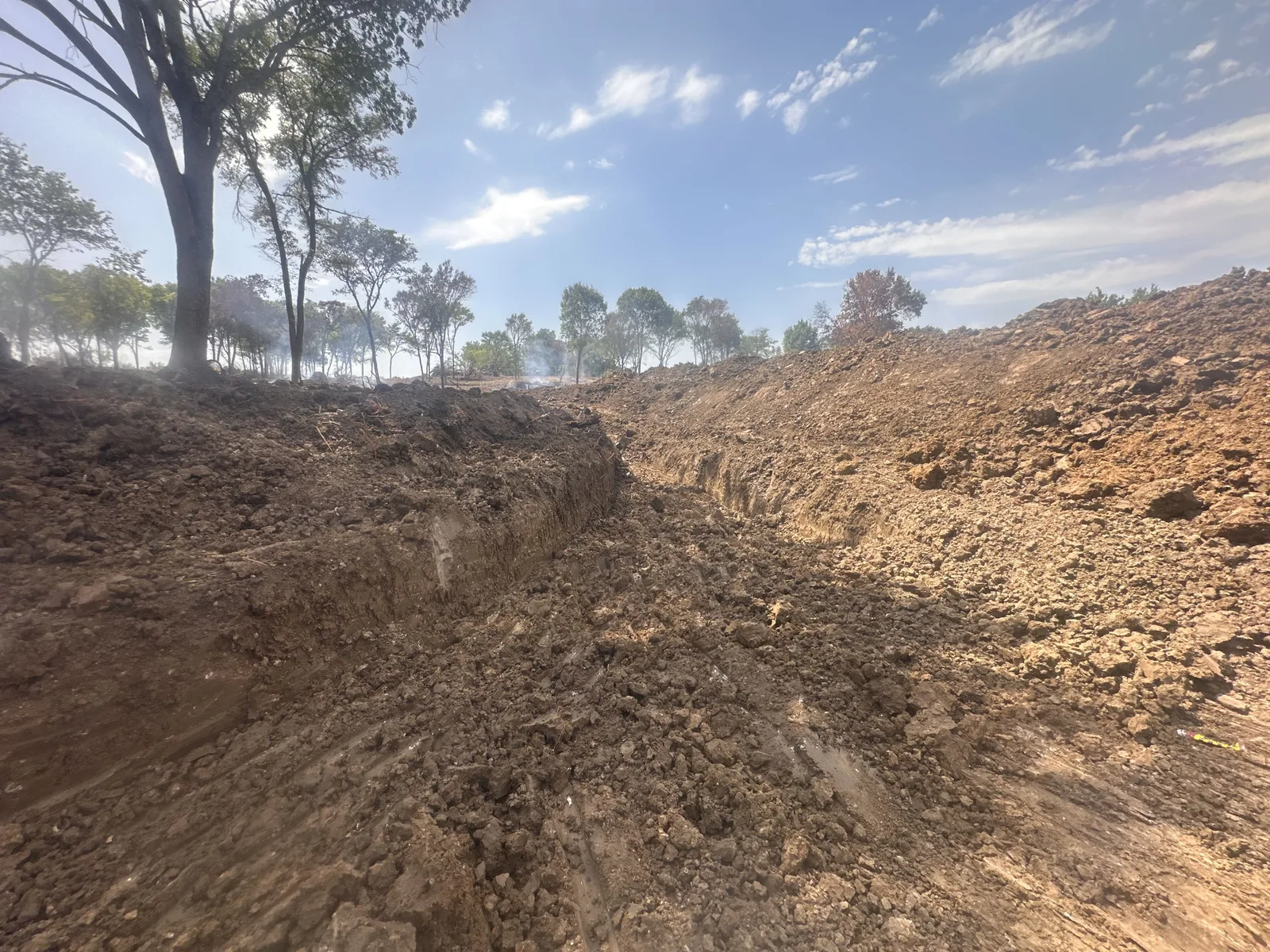
Our end is the dirt. We draw the pond down and pull the silt with the 30,000 pound excavator. The Cat D6 dozer pushes the basin back to shape.
A leaking dam section gets cut out in a broad V, the way SRAC describes. It is rebuilt with high clay dirt in thin lifts.
First we check the basin soil a foot or two down. Our page on how a new dam is built covers core trenches on new ponds. Hauling and placing clay dirt is the volume end of the work. Call (580) 344-7473 for a free estimate on a leaking pond.