Above-Ground vs Underground Storm Shelters: Which Is Safer in Oklahoma?
An above-ground storm shelter built and installed to FEMA P-361 is just as safe as an underground one. That is FEMA’s own line, from its guide to home safe rooms. The real differences are the site, the water, the access, the slab and the cost.
NWS Norman’s records average 59.4 Oklahoma tornadoes a year, so the choice matters here. We handle in-ground storm shelter installation out of Ada. We dig the hole, set the shelter, backfill and grade. For an above-ground unit, we rough in and level the pad, and a concrete crew pours the slab.
Are above-ground storm shelters safe?
Yes, when the shelter meets FEMA P-361. FEMA recommends every home safe room be designed for 250 mph tornado winds, wherever the house sits. The debris standard is a 15-pound 2x4 board traveling horizontally and hitting end-on at 100 mph. The National Storm Shelter Association points to ICC 500 and FEMA P-320 for design, debris impact testing, installation and inspection.
The two types meet that standard in different ways. An in-ground unit gets its debris protection naturally from the soil around it, FEMA explains. An above-ground unit is required to be rigorously tested for the same protection. FEMA’s bottom line is that all safe rooms offer life-safety protection when properly designed and built or installed.
FEMA’s guide also shows an above-ground safe room in a garage that performed well. An EF5 tornado hit that home in Joplin, Missouri, in 2011.
How do the two types compare side by side?
FEMA calls an underground shelter an in-ground safe room, one surrounded by soil on all four sides. An above-ground unit sits on a slab. Either type can sit outside the house, FEMA notes.
| Question | Underground (in-ground) | Above-ground |
|---|---|---|
| Safe when built to FEMA P-361? | Yes | Yes, just as safe |
| What it sits in or on | A dug hole, soil on all four sides | A reinforced concrete slab, often in a garage |
| What the anchors resist | Groundwater pushing it up | Wind sliding it or tipping it over |
| Inside a mapped flood hazard area | Not permitted below ground by ICC 500 | The type FEMA points to |
| Getting inside | Stairs down | Easier for people with mobility issues |
| Published price, per NerdWallet | $4,000 to $20,000 or more | $2,600 to $15,000 |
| SoonerSafe rebate | Counts when built to FEMA P-320, P-361 and ICC 500 | Same rule |
| Our part of the job | Dig, set, backfill and grade | Rough in and level the pad |
Can an underground storm shelter flood?
Yes. NerdWallet lists flood risk as the underground shelter’s drawback. In May 2015, a woman in Oklahoma drowned from flash flooding in a below-ground storm cellar. She was sheltering from a tornado, FEMA’s guide reports.
That drowning came in May. NWS Norman’s records show May alone averages 24.4 Oklahoma tornadoes.
In a Special Flood Hazard Area, ICC 500 does not permit a below-ground safe room. The same goes for one below the design flood elevation, and neither qualifies for FEMA funding. FEMA says to ask your local building official or floodplain manager whether a site floods. Its guide lists the FEMA Map Service Center as one source of flood maps.
Groundwater matters outside flood zones too. FEMA names a naturally high groundwater table as a reason to go above ground. NerdWallet says some areas restrict underground shelters because of soil conditions or high water tables.
Which one is easier to reach when a tornado is coming?
An underground shelter means stairs. FEMA notes that those stairs make it hard for someone using a wheelchair or crutches to get in quickly. NerdWallet lists easier access for people with mobility issues as an above-ground pro.
Distance counts for both types. ICC 500 requires the shelter’s access opening within 150 feet of travel distance from the nearest entrance of the house. For a shelter outside the house, FEMA says to get there early enough to avoid injuries. Wind, windborne debris, large hail and torrential rain are the hazards it names.
What does each type need from the ground?
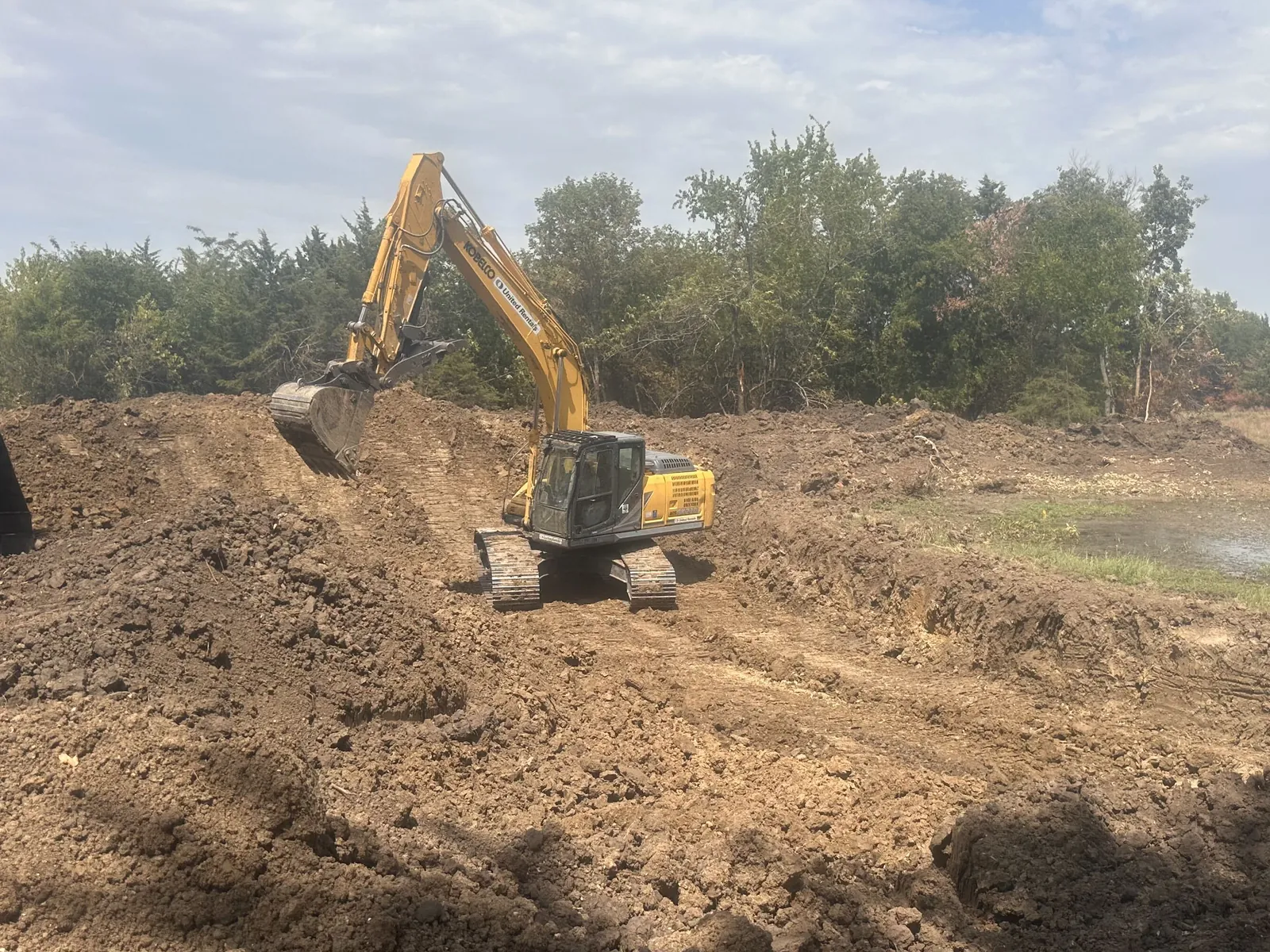
An underground shelter starts with a hole. FEMA says prefabricated in-ground units are readily available and easier to install than site-built ones. A hired shelter dig falls under Oklahoma’s OKIE811 rule: notice at least 48 hours ahead. The day of notice, weekends and legal holidays do not count.
We file an OKIE811 locate request before we dig. Our excavation and backfill work covers the hole and the ground around it. FEMA wants the ground graded to slope away from the entrance so runoff stays out. It also recommends a sump pump inside.
The unit has to be anchored so rising groundwater cannot push it out of the ground. NerdWallet says the in-ground price depends on the amount of excavation and waterproofing.
An above-ground shelter sits on concrete. NerdWallet describes a free-standing unit bolted into a reinforced concrete slab, often in a garage. Per FEMA, the vast majority of house slabs are not designed for a safe room’s extreme loads.
Often a section of the old slab is cut out. A new, thicker, more heavily reinforced slab with footings goes in. ICC 500 requires special inspections for a shelter on an existing slab with post-installed anchors.
On new ground, our site prep under a new slab gets the pad rough and level. The concrete crew takes it from there.
How do the published prices compare?
NerdWallet puts an underground or in-ground storm shelter at $4,000 to $20,000 or more. It puts an above-ground shelter at $2,600 to $15,000. Fixr says ground prep and excavation is often left out of the shelter price and runs $1,000 to $4,000.
Those are published market ranges, so ask what each quote covers. Our storm shelter price breakdown goes through the numbers by type.
SoonerSafe, the state rebate, treats both types the same. It counts any above or below ground shelter built and installed to FEMA P-320, FEMA P-361 and ICC 500. The maximum rebate is $3,000 per home, and never more than 75 percent of the actual cost.
The rebate is only a partial reimbursement after construction. As of October 2026, the state says the 2026 round is not open. The SoonerSafe FAQ also notes that many local building codes require a permit and inspection.
Which storm shelter fits your property?
The right type depends on the site and the people who will use it. A mapped flood zone, a high water table or a mobility need points above ground. Dry ground with a spot within 150 feet of the house suits an underground unit.
Planning a new house? FEMA says a safe room typically costs more in an existing home than in a new house. That makes the pad stage a good time to decide.
On an ongoing ranch project near Sulphur, we set a storm shelter and roughed in three building pads. Our estimate is free and comes from looking at the ground and the way in. Call (580) 344-7473 about a shelter dig or a pad.