Backhoe vs Excavator: Which One Does Your Oklahoma Job Need?
A backhoe loader is a wheeled tractor with a loader bucket up front and a digging arm in back. That arm swings about 200 degrees. An excavator’s house and arm turn a full 360 degrees, and tracks carry it on bigger jobs. A backhoe suits short trenches and small jobs strung along a paved road.
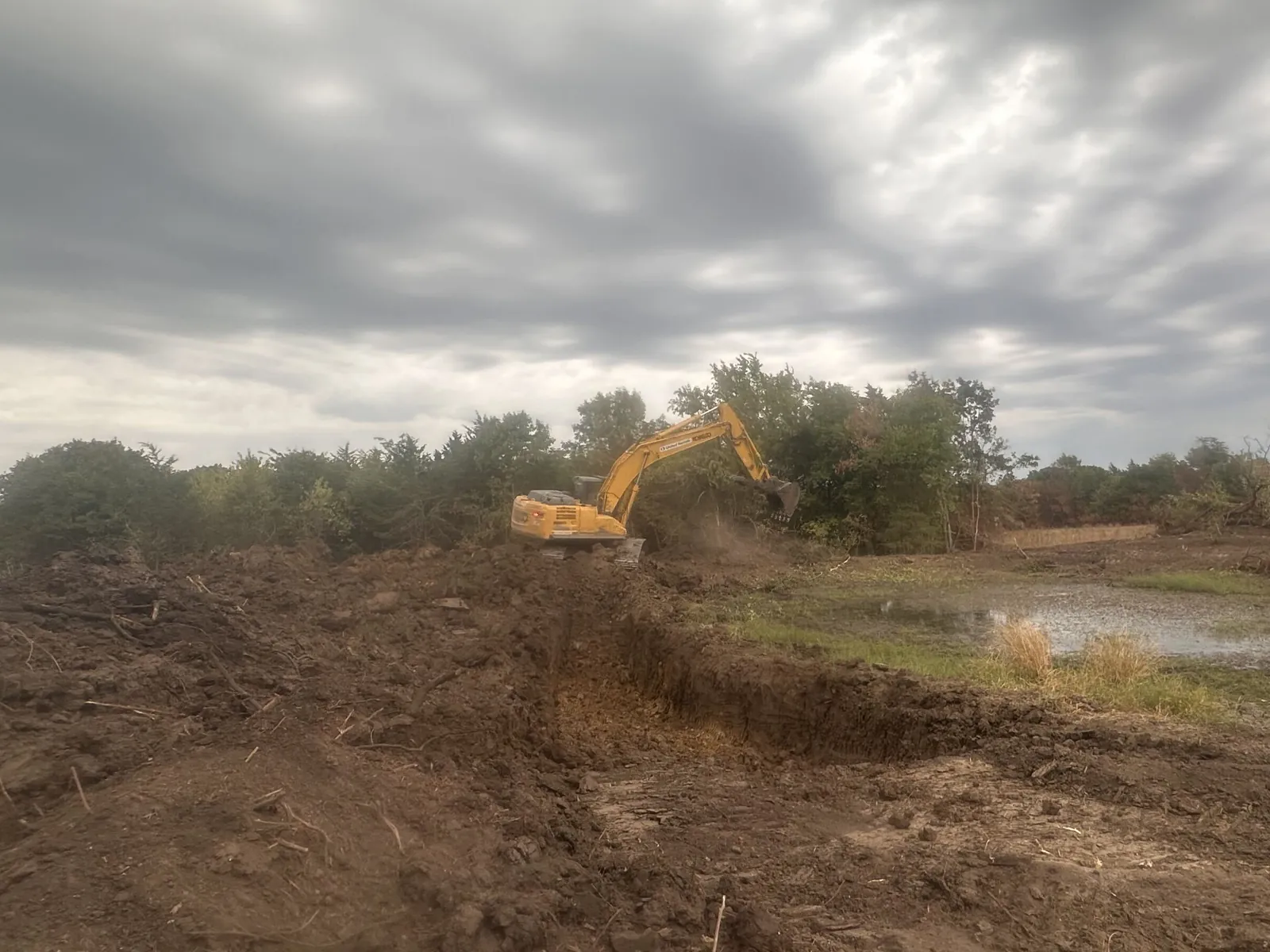
Ponds, root balls, demolition, big pads and long days of digging go faster with an excavator working beside a dozer. As an excavation contractor in Ada, we run a 30,000-pound excavator and a Cat D6 dozer. A tracked skid steer works the tight spots. Our jobs are the ones where the excavator wins.
What is the difference between a backhoe and an excavator?
A backhoe loader is built on a tractor-like unit. SANY, the equipment maker, calls it a dual-function design: dig at the back, load at the front. Digging on tires makes the machine rock. So most backhoes set hydraulic stabilizers at the rear and lower the loader bucket before they dig.
An excavator’s house sits on an undercarriage with tracks or wheels. SANY calls its 360-degree continuous rotation the excavator’s most distinctive feature. The bucket works in any direction without the machine moving. Tracked excavators are sometimes called trackhoes, a name borrowed from the backhoe.
How do a backhoe and an excavator compare side by side?
The weight ranges below come from SANY. The sample models and their figures come from Cat’s spec sheets.
| Feature | Backhoe loader | Excavator |
|---|---|---|
| Rides on | Tires | Tracks or wheels, tracks on larger projects |
| Swing | About 200 degrees | A full 360 degrees |
| Weight range (SANY) | About 6,600 to over 44,000 lb | Medium class: 30,000 to 70,000 lb |
| Sample model | Cat 420, about 17,271 lb | Cat 313, 30,400 lb |
| Dig depth of that model | 14 ft (standard) | 19.2 ft (maximum) |
| Getting between jobs | Drives on the road, 25 mph top gear (Cat 420) | Tracked models get hauled site to site |
| Before it digs | Sets stabilizers, lowers the loader bucket | Digs from where it sits |
| Best fit | Short trenches, small jobs along paved roads | Ponds, root balls, demolition, big pads |
When does a backhoe make more sense?
A backhoe pays off on small jobs spread out along paved roads. It rolls on tires, and Cat lists 25 mph in top gear for its 420 backhoe loader. SANY says the backhoe’s small size makes moving it convenient and low cost.
Backhoe loaders are very common on small construction projects and city road repairs. The loader bucket up front carries light loads of material around the site. A short trench beside a driveway, with a little gravel to move, fits that machine well.
SANY gives the backhoe a better cost-performance ratio on routine shallow digs. For deep, heavy digging, it points to the excavator.
When is an excavator the better machine?
Big, open digs favor the excavator. SANY says the 360-degree swing lets it work all the way around without moving the chassis. It digs on one side and stacks spoil or loads a truck on the other. SANY notes the backhoe’s 200-degree swing cuts its efficiency on wide-ranging work.
Depth and reach go to the excavator too. Cat lists a 14-foot standard dig depth for its 420 backhoe loader. Its 313 excavator weighs 30,400 pounds, close to the 30,000-pound excavator we run. Cat lists that 313 at 19.2 feet of digging depth and 28.4 feet of reach at ground level.
Ground matters as much as depth. Tracks spread an excavator’s weight, so it stays on top of soft or wet clay. A backhoe on tires rocks as it digs, and SANY lists reduced stability among its limits. For larger projects, a tracked excavator is the usual machine.
For farm ground, SANY says a mid-sized excavator typically offers the best return on investment. It clears land and moves heavy loads more effectively than a backhoe loader. Land clearing and dirt work are the core of what we do.
That is why our stump and pond work runs on the excavator. It lifts a stump out with the root ball attached, and the hole gets backfilled. On our pond construction jobs, the dozer and excavator dig the basin together. On an ongoing ranch job near Sulphur, we have built four ponds and roughed in three building pads.
Do you need a dozer or an excavator?
On our clearing and pad jobs, the answer is both. The Cat D6 dozer does the pushing. It moves big volume in long passes and holds an even cut. The excavator digs and loads, and it handles anything that has to come out of the ground.
Debris gets piled and burned on site where county rules allow it, or hauled off. Then the holes get backfilled and the ground gets rough graded. Our dozer and excavator dirt work leaves land ready to mow, seed, fence or build on.
What does each machine cost to hire?
HomeGuide puts operators who bring their own mini excavator, backhoe or skid steer at $100 to $300 an hour. Most operators charge a one-day minimum of eight hours, by HomeGuide’s count. Renting a mini excavator and running it yourself costs $200 to $700 a day, HomeGuide says.
Those are published national ranges, and the price of a job depends on the site. Our estimates are free and come from looking at the property. For more on pricing a dig, read our guide to excavation prices.
What safety rules apply to a trench dig?
OSHA requires cave-in protection for workers in an excavation, with two exceptions. One is a dig made entirely in stable rock. The other is a dig under 5 feet deep, where a competent person sees no sign of a cave-in. Both machines dig well past 5 feet, so the rule covers backhoe and excavator trenches alike.
We file an OKIE811 locate request before we dig. A hired dig, like a trench, footing, pool or storm shelter, falls under Oklahoma’s 811 law. That law requires notice at least 48 hours ahead. The count leaves out the day of the call, Saturdays, Sundays and legal holidays.
Which machine does your Oklahoma job need?
Hire a backhoe for short trenches and small jobs strung along paved roads. Hire an excavator for ponds, root balls, demolition, big pads and long days of digging. If the job moves a lot of dirt too, plan on a dozer beside the excavator.
Matching the machine to the job is the point. A Google review from Lincoln reads: “Shows up with the right equipment and makes sure the job is done right.”
Call (580) 344-7473 for a free estimate on excavator work within about 50 miles of Ada. Bigger jobs pull the machines further.