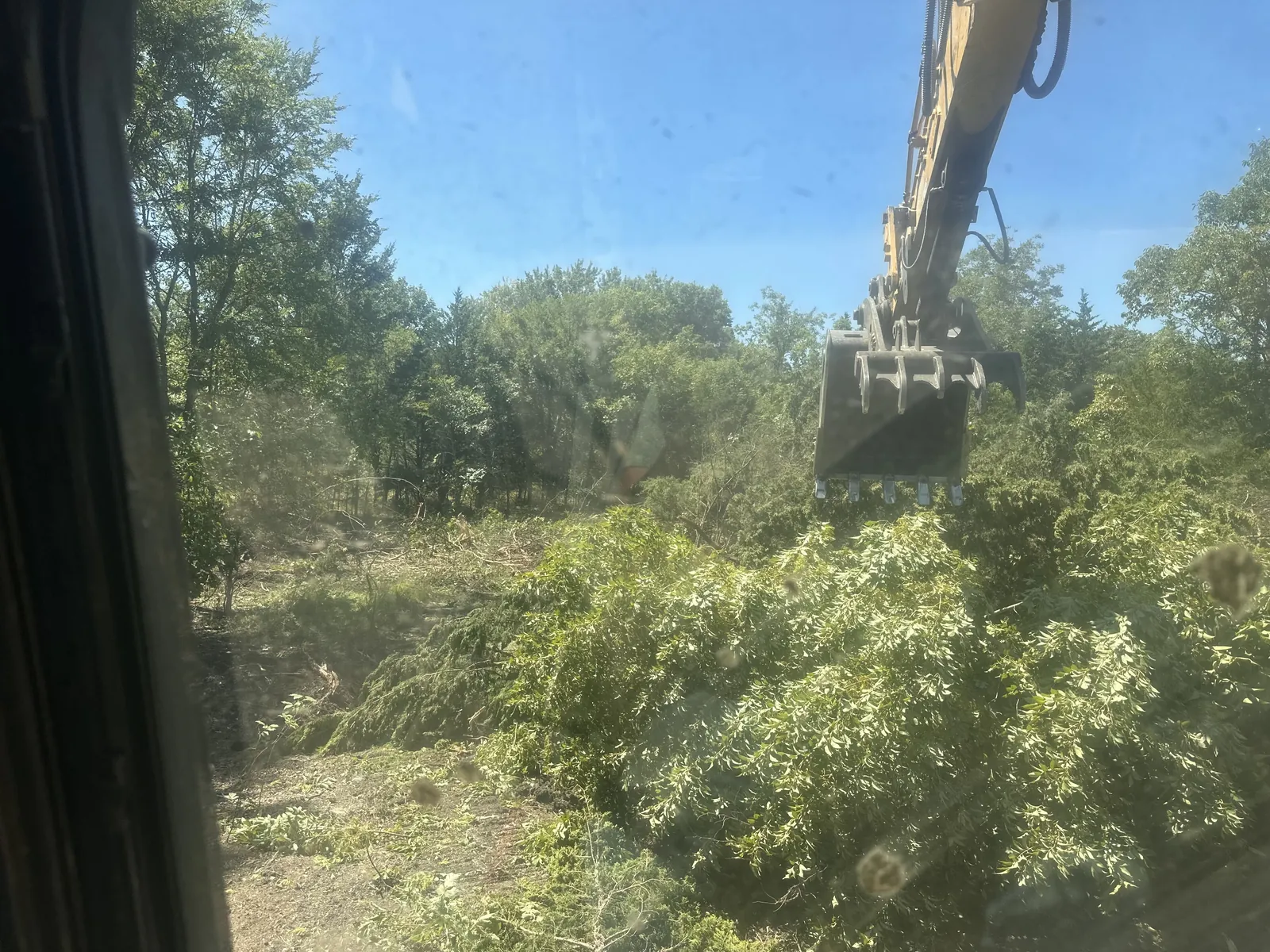
Excavation in McAlester means digging in ground that pushes back. Pittsburg County runs hilly to mountainous, and the Ouachita Mountains reach into its southeast corner. Under the topsoil sits the McAlester Formation, mostly shale with sandstone ledges and old coal beds. That rock is why a dig here takes longer than the same dig on flat farm ground. We work out of Ada, roughly 50 miles west of town. A Cat D6 dozer and a 30,000-pound excavator handle the hard spots.
Mobilizing machines 50 miles costs real money. So we favor full-scope jobs out here over quick one-hour digs. One move, and we stay until the dirt work is finished. A typical McAlester call covers the homesite pad, plus the water and power trench that has to reach it. That bundle is what our excavation work usually involves. We run the same scope on an ongoing ranch job near Sulphur. Four ponds and three building pads are already in there. Call (580) 344-7473 and we will set a time to come look at the ground.
Tell us about your property and we'll get back to you fast.
Shale breaks up under a bucket. Sandstone ledges do not. On the hill ground around McAlester both sit close to the surface. The McAlester Formation was named from the rock right here in Pittsburg County. It sits on top of the Hartshorne Sandstone. So a footing trench that runs easy for thirty feet can stop cold on a ledge. We read that early by opening a test hole or two along the actual dig line. A 30,000-pound excavator with a rock bucket takes most of what this ground holds. When a ledge is thicker than that, the D6 rips it loose in lifts. The excavator then cleans out the trench.
McAlester grew on coal. The county was even named for Pittsburgh because leaders liked how its coal output compared. Mining faded after 1920 and stopped being reported by 1966, but the ground remembers it. Old workings and filled pits still turn up on rural tracts around town. Spoil ground is loose and mixed, and it settles at a different rate than native soil. That matters when a pad or a footing lands on top of it. So on older tracts we ask what the place was used for, then dig to see. If we find made ground, we cut it out and rebuild the fill in compacted lifts. Then we bring it to a finished grade that sheds water.
Most McAlester digs touch a county road somewhere. A new drive needs a culvert under it, and a homesite needs water and power brought in. Both of those cross county right of way, and Pittsburg County permits that work. The application goes to the Board of County Commissioners, whose office sits on East Carl Albert Parkway in McAlester. It asks for the culvert pipe diameter and length. It also asks whether the line is bored under the road or trenched across it. The Floodplain Administrator has to make a determination before the commissioners will act. Applications are due at least five days before a commissioners meeting. When the crossing is finished, the county wants a call for an onsite inspection.
Water sets the second rule. Eufaula Lake wraps the north end of the county, with 102,200 surface acres and roughly 600 miles of shoreline. The Canadian River drains most of Pittsburg County and feeds it. So good building ground near the lake often sits in a mapped flood zone. The county floodplain permit has a box for adding fill and another for burying pipe or cable. That covers most of a dig. It also wants the flood zone and the base flood elevation. Hauling clean fill up a hill road costs more than moving dirt across a flat site. So we plan the cut and fill to balance on the property where grades allow.
More about the service itself is on our Excavation page, and everything we do around town is on the McAlester service-area page.
Answers specific to excavation work around McAlester. Something else on your mind? Call us.
Cedar taking the pasture, a pad to build, an old house to take down, or a pond you have been thinking about for years? Call or send the form. We come look at the property with you, and the estimate is free, from the owner who runs the machines.
Tell us about your property and we'll get back to you fast.